
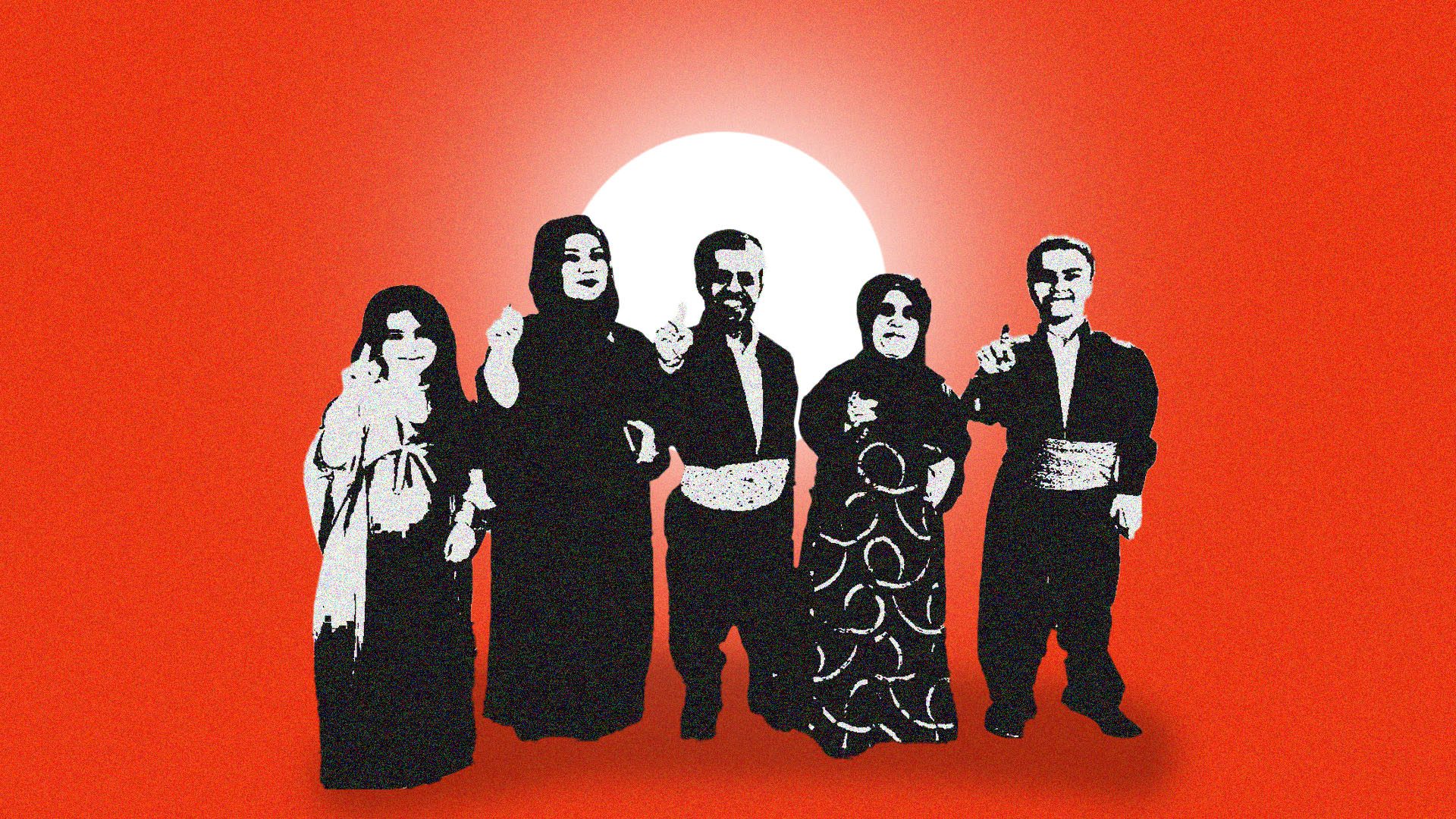
Nasreen Aziz had just finished her meal at a restaurant in Erbil. She enjoyed it, but now what should be a simple task has turned into yet another moment of discomfort.
She needs to head to the sink to wash her hands and use the paper towels mounted on the wall to dry them. And here comes the embarrassing part: she is a person of short stature.
The sink is too high; the paper towels are out of reach. So, she’ll have to ask one of the nearby girls for help—a situation she wishes she could avoid, but she has no other choice.
“Restaurants and public spaces don’t offer services for people of short stature. No sinks, not even chairs or tables,” she tells Jummar.
Her condition causes constant fatigue, even while walking. But the challenges don’t end here.
Government offices offer no accommodation for people like her: no appropriate stairs, chairs or restrooms. Not a single consideration.
Sairan Adel, a person of short stature, shares many of Nasreen’s struggles, and adds another: finding clothes that fit her.
She often resorts to shopping in children’s clothing stores, not by choice but by necessity. Yet the styles rarely match her age or identity, often putting her in uncomfortable and painfully awkward situations.
To make them wearable, Sairan brings the garments to a tailor for adjustments. It’s a workaround—not a solution—in a market that offers no clothing options designed for people of her stature.

Waheed Saeed, Vice President of the Kurdistan Short Stature Association, says the association reached out to several clothing merchants to advocate for designs that meet their community’s needs. But their response has been dismissive, stating the number of people of short stature doesn’t make a profitable consumer base.
Children’s clothing is not a viable alternative. Differences in body structure, particularly in the waist and hips area, make children’s clothing a very poor substitute.
The challenges extend far beyond clothing. At home, Sairan struggles with everyday tasks most people take for granted like reaching the top shelves of her wardrobe or kitchen cabinets. Even simple chores like cleaning or changing the battery of a wall clock demand a considerable amount of effort.
Saeed recalls facing similar barriers in the classroom. At university, he had to build his own custom seat because the standard classroom chairs did not accommodate his height.
Widespread unemployment
According to Saeed, people of short stature—men and women—face significant financial hardship, with unemployment widespread across their community. They are left with scarce opportunities across public and private sectors.
As a result, many rely solely on monthly social welfare payments. In the Kurdistan Region, this monthly allowance does not exceed 150,000 Iraqi dinars, about 100 US dollars—an amount far below what is needed to cover basic living costs.
“Outside of Kurdistan, the allowance reaches 300,000 Iraqi dinars, around 200 US dollars,” Saeed told Jummar.
To address this exclusion, Saeed is calling for a reserved quota seat in the provincial councils of Kurdistan and the parliament, as well as designed government jobs for people with disabilities— including those of short stature—to ensure their full participation and access to rights.
While Article 2, Paragraph 1 of the 2012 Law on the Care of People with Special Needs, which was issued by the Kurdistan Parliament, guarantees the fundamental rights and freedom of all persons with disabilities on an equal basis with others, this has yet to be reflected in political or institutional representation.
Currently people of short stature are not represented within the government or the parliament, either in Kurdistan or elsewhere in Iraq. One of their representatives attempted to run for office but fell short on support.

In the 2014 Iraqi parliamentary elections, Muhammad Aidan Jabbar—head of the Short Statured People of Iraq—ran for parliament in an effort to represent his community at the national level. Despite his campaign, he did not secure enough votes to win a seat.
Omar Jabbar, head of the Short Statured People Association in Sulaymaniyah, painted a bleak picture of the ongoing neglect and marginalisation faced by the community. He stated that the time has come for practical action, as issuing statements and staging protests have failed to get them any results.
“People of short stature live under harsh conditions,” he told Jummar. “Some suffer from health issues, while others face difficult social and economic circumstances.”
Many individuals of short stature drop out of school due to accessibility issues, discrimination, or lack of support, and struggle to find employment afterwards.
Jabbar plans to travel to Baghdad to meet with officials and politicians, present the challenges facing people of short stature in Kurdistan, and demand adjustments to their welfare payments to match those provided elsewhere in Iraq.
Like others in his community, Jabbar expressed deep frustration with political neglect. During election seasons, candidates crowd their doorsteps in search of votes only to disappear, along with their promises, once the ballots are cast.
There are thousands
People of short stature—often referred to medically as having dwarfism—are characterised by short height and sometimes accompanied by syndromes.
There are two primary forms of dwarfism. The first is Proportionate Short Stature (PSS), a general deficiency in growth, including the body, arms, and legs. The most common cause is the short stature of the parents, but sometimes it results from the body not producing enough growth hormone. It can also be caused by genetic syndromes such as Turner, Noonan, and Prader-Willi.
The second type is Disproportionate Short Stature (DSS), where the arms and legs are particularly short. This occurs due to a rare genetic condition called achondroplasia, which leads to poor bone growth.
Sometimes, growth hormone deficiency is due to a genetic mutation or an injury, but generally, there is no clear known cause for this disorder.
Dwarfism can also be accompanied by health complications ranging from joint and spinal issues to neurological and respiratory problems.
There are no official government statistics on the number of people of short stature in Iraq, but unofficial estimates suggest there are more than 8,000.
The Kurdistan Short Stature Association estimates their number to be around 5,000.
Pierre Bafi, a social researcher, emphasised the need for society and government institutions to care for this group.
Bafi expressed his regret over the marginalisation, difficult living conditions, and bullying that people of short stature face.
He told Jummar, in his own words: “These people are capable of working and living normal lives, but they still face negative perceptions that affect their self-confidence.”
Perhaps it is this negative perception that Bafi spoke of that led Hala Al-Tayyib, a woman of short stature from Kurdistan, to stop even caring about her hairstyle, as she lives under immense psychological pressure.
The mirror challenge
Despite the daily discrimination and barriers faced by people of short stature, many have consciously chosen to resist despair and prevent it from taking root in their hearts. Some have turned their pain into purpose—organising motivational activities to uplift others in their community.
Naseeba Ismail is one such advocate. She founded an organisation dedicated to empowering people of short stature through social and cultural initiatives. Through her work, she focuses on building self-confidence, improving communication skills and encouraging greater engagement with society at large.
“I work to encourage them to live their lives normally, to leave their homes and interact with others, and to introduce them to society, public spaces, markets, and archaeological and tourist sites,” Naseeba told Jummar.
However, fear of bullying continues to keep many—especially women and girls—isolated in their homes. Through her advocacy and outreach, Ismael discovered that some individuals avoid even looking at themselves in a mirror, a reaction to the overwhelming effects of social stigma.
In response, she launched a selfie challenge inviting people of short stature to take photos of themselves in the mirror and post them on social media. The goal: to foster self-acceptance and visibility.
The challenge resonated widely with a large number of both women and men taking part.

At the entrance of the organisation she founded, Naseeba Ismail placed a large mirror—not for decoration, but as a statement. She wanted members to see themselves each time they walked in or out of the building, to face their reflection with pride rather than hesitation.
Ismail reaped the fruits of her efforts. Many people of short stature, both women and men, gained self-confidence to pursue education, careers, hobbies, and social lives once hindered by stigma. Some began participating in sports and artistic events, while others formed lasting relationships.
She also helped many people meet through the organisation; a number of these connections even led to marriage.
Among them is Parwin Khairy, 39, who broke from societal expectations by choosing a tall partner. Her fiancé, Hashim, 45, shares her passion for life and mutual respect. The couple, who live in Erbil, are preparing for their wedding.

Parwin told Jummar that she had never considered marriage until she met Hashim. As she expressed her excitement for their wedding and wearing the white dress, she affirmed that he helped her realise how much they have in common and accept each other fully.
In Duhok, Hala’s story also reflects resilience and achievement. With the encouragement of her family, she pursued education with determination. After graduating with distinction from the Faculty of Law, she joined the Legal Affairs Department at the Duhok Municipality. She later worked at the Integrity Commission, where she contributed to investigations and legal reviews. Now, with a master’s degree completed, she is preparing to pursue her PhD.